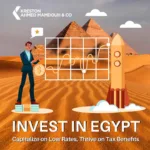
Egypt is one of the leading emerging investment destinations in the Middle East and Africa, offering a unique combination of strategic location, a large consumer market, and advanced infrastructure. Despite global and domestic economic challenges, the country has succeeded in turning crises into opportunities through a package of structural and legislative reforms. International companies should consider investing in Egypt not only as a base for domestic growth, but also as a gateway to global markets.
Investing in Egypt today is not merely about benefiting from traditional advantages such as location and labor; it is about participating in an economic growth story supported by genuine political will that removes obstacles to foreign capital and provides a secure, sustainable business environment with strong long-term profit potential.
- Egypt lies at the crossroads of three continents and controls the Suez Canal, through which approximately 15% of global trade passes, making the country an unparalleled logistics hub.
- Egypt has a large domestic market of more than 110 million people, most of whom are young. This provides a cost-competitive and highly capable workforce, alongside growing purchasing power.
- Egypt gives investors access to more than 1.5 billion consumers without customs duties through agreements including the partnership with the European Union, the African Continental Free Trade Area Agreement, and the Agreement on the Facilitation and Development of Trade among Arab States.
- Egypt has witnessed a massive expansion in road networks, ports, and energy resources, in addition to the development of the New Administrative Capital and the Suez Canal Economic Zone, which offers special tax and customs incentives.
- Egypt is rapidly emerging as a regional hub for the production of green hydrogen, solar energy, and wind power, supported by major projects in the Red Sea and Aswan.
Why International Companies Should Consider Investing in Egypt
The current timing in 2026 represents an especially favorable window for entering the Egyptian market: structural reforms are no longer merely promises but have been reflected in tangible figures and sustainable growth. International companies seeking to reduce production costs, secure supply chains, and gain rapid access to African and European markets will find Egypt to be an ideal strategic partner for growth over the coming decade.
Egypt is currently a highly attractive investment destination for international companies, given its strategic geographic location, expanding market, and recent economic reforms. Its investment climate is undergoing a profound structural transformation: the Egyptian economy recorded a growth rate of 5.1% in the previous fiscal year, accompanied by a 33.7% increase in the establishment of new foreign companies during the first half of 2026 alone, reflecting a strong increase in international investor confidence. This can be attributed to Egypt’s distinguishing features, including:
Strengths
Egypt possesses economic and geographic foundations that make it a strategic center for global production and distribution:
- Geographic location and the Suez Canal: Egypt is located at the crossroads of three continents and controls the Suez Canal, through which approximately 15% of global trade passes, making it an unparalleled logistics platform.
- Highly developed infrastructure: The state has invested hundreds of billions in modernizing road networks and seaports, developing a new generation of smart cities (such as the New Administrative Capital), and upgrading the energy and electricity sectors to meet the needs of large-scale manufacturing plants.
- Large consumer market and competitive workforce: Egypt’s population is approximately 110 million, with young people representing the majority (more than 60% of the population is of working age). This ensures a substantial domestic market and an abundant skilled workforce at operating costs that are competitive with Europe and the Gulf.
- Free trade agreements: These agreements provide duty-free access to markets comprising more than 1.5 billion consumers through arrangements including the European partnership, COMESA in Africa, the Greater Arab Free Trade Area, and Mercosur.
Opportunities
The Egyptian economy is currently focusing on a transition toward productive, green, and technology-driven sectors:
- Renewable energy and green hydrogen: Egypt seeks to raise the share of renewable energy to 42% by 2030. The Suez Canal Economic Zone is attracting billions of dollars in investments in green hydrogen and green ammonia projects.
- Export-oriented manufacturing: Significant opportunities exist in automotive, textiles, chemical, and food industries, where the state offers substantial tax and customs incentives to factories that rely on local components and are export-oriented.
- Telecommunications and information technology: This is the fastest-growing sector, with annual growth rates ranging from 14% to 16%, driven by digital transformation programs, technology-services exports, and data-center outsourcing.
- Government offerings and privatization program: The government is opening the door for international companies to acquire stakes in or partner with strategic sectors such as insurance, banking, and energy, while listing major state-owned companies on the stock exchange to expand private-sector participation.
Weaknesses and How They Have Been Addressed
Through bold structural reforms supported by the International Monetary Fund and international partners, the Egyptian government has worked to address long-standing weaknesses:
Foreign-exchange gap and currency volatility
- Weakness: Companies previously faced difficulties in transferring profits abroad and had to navigate multiple exchange rates.
- Response: Exchange-rate liberalization (full floating), supported by major investment transactions (such as Ras El-Hekma and development agreements), helped eliminate the parallel market and stabilize foreign-exchange reserves at more than USD 57 billion, ensuring full freedom for the movement of capital and profits into and out of the country.
Bureaucracy and lengthy procedures
- Weakness: Overlapping jurisdictions and slow licensing processes.
- Response: The activation of the “Golden License” provides investors with a single, comprehensive approval covering construction and operating permits within a matter of days. This is complemented by a “one-stop shop” system through the General Authority for Investment and Free Zones (GAFI), together with full digitalization of company-incorporation procedures.
High inflation and interest rates
- Weakness: High domestic financing and operating costs.
- Response: The state is adopting comprehensive tax relief packages and customs exemptions for industrial investors to mitigate the impact of inflation, alongside monetary policies aimed at gradually reducing inflation rates.
Threats and Mitigation Strategies
The regional and global environment presents challenges, but Egypt’s strategic approach has succeeded in containing these risks:
Regional geopolitical tensions
- Threat: The impact of regional instability on revenues in certain sectors, such as the Suez Canal and tourism.
- Response: Diplomatically and politically, Egypt has demonstrated that it is an “oasis of stability and security” in the region. This stability has strengthened its position as a secure alternative destination for global supply chains serving Europe and Africa.
Intense regional competition for capital
- Threat: Competition among neighboring and Gulf countries to offer attractive incentives to global companies.
- Response: Egypt does not compete as a financial center; rather, it competes as an integrated regional industrial and logistics center. Its lower production and labor costs, together with the availability of serviced industrial land, give Egypt a price and productivity advantage that other regional financial centers cannot offer with the same level of efficiency.
Key Dimensions That Make Investment in Egypt a Strategic Choice
Geographic location and international connectivity
- Crossroads of continents: Egypt is located at the heart of the world and connects Africa, Asia, and Europe.
- Suez Canal: The world’s most important maritime corridor, making Egypt a major hub for supply chains and logistics services.
- Free trade agreements: Egypt gives companies access to markets of more than 1.5 billion consumers without customs duties through agreements such as the European partnership, COMESA (Africa), and the Greater Arab Free Trade Area.
Advanced infrastructure
- Modern transport arteries: Egypt has experienced an unprecedented expansion in road networks, seaports, and airports.
- Sustainable energy: Egypt has transformed from a country suffering from an energy deficit into a regional hub for gas and electricity trading, with major emphasis on green hydrogen and solar-energy projects.
- Smart cities: The New Administrative Capital and fourth-generation cities provide a digital, integrated business environment for global companies.
Investment incentives and the legislative environment
- Golden License: The government grants a single, comprehensive license covering all construction and operating permits for strategic projects, accelerating the start of operations.
- Special economic zones: The Suez Canal Economic Zone provides exceptional tax and customs incentives for manufacturers and exporters.
- Structural reforms: Ongoing amendments to investment, intellectual-property, and bankruptcy laws aim to protect the rights of foreign investors.
Large consumer market and competitive workforce
- Demographic strength: Egypt’s population exceeds 110 million, representing a large and diverse consumer market.
- Young population: More than 60% of the population is under the age of 30, providing a young and qualified labor pool.
- Cost competitiveness: Egypt offers skilled labor, particularly in engineering, information technology, and call-center services, at operating costs that are competitive with Europe and the Middle East.
Promising sectors for immediate investment
- Technology and telecommunications: Data centers and digital-services outsourcing.
- Renewable energy: Wind, solar, and green-ammonia projects.
- Manufacturing industries: Automotive assembly, pharmaceuticals, and food processing.
- Logistics services: Maritime transport, warehousing, and re-exporting.
Why Egypt?
Egypt offers promising investment opportunities that make it an attractive destination for international companies. It is a strategic market linking three continents, with advanced infrastructure and competitive investment incentives. The key factors that make Egypt an attractive destination for foreign investment are:
Market size and access
- Large consumer market: Egypt has the largest population base in the Middle East and North Africa (more than 110 million people), creating substantial and sustainable domestic demand for a wide range of goods and services.
- Gateway to global markets: Egypt enables companies to access more than 1.5 billion consumers in Europe, the Middle East, Africa, and the Americas on a largely duty-free basis through an extensive network of trade agreements.
Strategic location
- Heart of global trade: Egypt sits at the intersection of major trade routes linking Africa, Asia, and Europe.
- Suez Canal: Approximately 15% of global seaborne trade passes through the canal, making Egypt a unique logistics hub that reduces shipping costs and international transit times.
- Suez Canal Economic Zone: Provides an integrated industrial and logistics center that gives investors direct access to global markets.
Workforce and infrastructure
- Young and cost-competitive workforce: Young people (under 35) account for approximately 60% of society, and the workforce is qualified, educated, and available at wage costs that are highly competitive with regional and European markets.
- Infrastructure expansion: Egypt has comprehensively modernized its road network, seaports and airports, and expanded the energy sector (electricity and natural gas), helping ensure a stable operating environment for industrial and service companies.
Trade advantages and international agreements
Egypt is party to multiple multilateral free trade agreements that give locally manufactured products a major competitive advantage:
- African Continental Free Trade Area Agreement: Opens access to the promising African market.
- Egypt-EU Association Agreement: Enables duty-free exports to European markets.
- Qualifying Industrial Zones (QIZ): Provide customs-duty exemptions for exports to the United States, subject to specified conditions.
- Agreement on the Facilitation and Development of Trade among Arab States (Greater Arab Free Trade Area).
Tax and investment incentives
Egypt’s Investment Law provides attractive incentives and guarantees for foreign investors, including:
- General and special incentives: Tax deductions of up to 50% of investment costs for projects in specified sectors and geographic areas, such as green hydrogen, renewable energy, and information technology.
- Golden License: A single, comprehensive approval covering incorporation, construction, and operating permits for strategic and national projects, accelerating the commencement of activities.
- Free-zone advantages: Full tax and customs exemptions for imported goods and equipment for export-oriented projects established within free zones.
Main Business Taxes in Egypt
Corporate income tax
The standard corporate income tax rate in Egypt is 22.5% of annual taxable net profits. This rate is competitive, stable, and aligned with international standards, giving foreign companies greater financial visibility when planning their operations. The rules and rates applicable to corporate income tax in Egypt are as follows.
Tax rates by sector
While the standard rate applies to most commercial and industrial activities, certain key sectors are subject to different rates:
- General and commercial activities: standard rate of 22.5%.
- Oil and gas exploration companies: 40.55% of profits.
- Certain major entities: The profits of the Suez Canal Authority, the Egyptian General Petroleum Corporation, and the Central Bank of Egypt are subject to a 40% tax rate.
Scope of corporate tax liability
- Resident companies: Tax is imposed on worldwide income (income generated inside and outside Egypt). A company is considered resident if it is incorporated under Egyptian law or if its effective place of management is in Egypt.
- Non-resident companies: Tax is imposed only on income derived from a permanent establishment in Egypt.
Tax incentives and exemptions for international investors
Egypt offers significant financial incentives to attract international companies through its Investment Law:
- Free zones: Companies establishing projects within free zones benefit from a full exemption from corporate income tax for the entire licensed period of the activity.
- Special economic zones: Areas such as the Suez Canal Economic Zone offer investment incentives and tax deductions of up to 50% of project investment costs in certain promising areas.
- Small and start-up companies: Egypt provides a simplified and significantly reduced tax regime for companies whose annual turnover does not exceed a specified threshold, in order to encourage entrepreneurship.
Loss carry-forward rules and digital compliance
- Loss carry-forwards: Companies may carry forward business losses to offset profits in subsequent years for up to five years.
- E-invoicing and digitalization: Egypt has adopted an advanced system for electronic invoices and returns, enhancing transparency, accelerating procedures, and protecting compliant companies from arbitrary assessments.
Value added tax (VAT)
Egypt is an attractive investment destination for international companies because of its highly competitive operating and employment costs, combined with a modern package of tax facilitation measures. The VAT structure and employment costs are set out below in detail to support investment feasibility assessments.
Egypt applies a flexible VAT system designed to support manufacturing and export sectors:
- Standard rate: 14% on most goods and services.
- Manufacturing and medical-services incentives: The rate has been reduced to only 5% on machinery, equipment, and medical devices used to produce goods or provide services.
- Tax deferral and suspension: The new system permits the suspension of VAT payment on imported machinery and equipment for factories for up to four years; where their use in industrial production is demonstrated during that period, the VAT is waived entirely.
- Export advantage (zero rate): Companies exporting goods or services (such as software, information-technology, and call-center outsourcing companies) are subject to VAT at a 0% rate, allowing full recovery of input VAT and making export operations highly competitive.
- Accelerated VAT refunds: The period for refunding VAT credit balances has been reduced to only four tax periods (or three months for small enterprises), improving companies’ cash liquidity.
Employment costs and wage structure
Egypt provides a skilled workforce at costs that are competitive with regional and international markets. The financial burden of employment is distributed as follows:
A. Social insurance contributions
Contributions are calculated as a percentage of the “insured wage”, which is subject to annual minimum and maximum limits (minimum insured wage: EGP 2,700; maximum: EGP 16,700 per month).
- Employer share: 18.75% of the employee’s insured wage (21% for board members and managers registered in the Commercial Register).
- Employee share: 11%, deducted from the employee’s salary and remitted by the company.
- Comprehensive Health Insurance: The employer contributes an additional 3.25% toward employee healthcare coverage in governorates where the system has been implemented.
B. Wage and salary taxes
Egypt applies a progressive income-tax system to wages, with the employer legally responsible for calculating the tax, withholding it monthly from employees’ salaries, and remitting it to the Tax Authority.
- Personal exemption: The employee receives an annual personal exemption of EGP 20,000, in addition to the zero-rate income-tax bracket.
- Tax brackets: Rates start at 0% and increase progressively to a top rate of 27.5% for very high-income earners.
C. Minor payroll contributions and other funds
Companies are subject to certain additional minor deductions to support labor and social funds:
- Training and Qualification Fund: The employer is required to pay 0.25% of the insured wage to support workforce training.
- Fund for Honoring Martyrs and Victims of Terrorist Operations: A deduction of 0.05% of total salary.
- Emergency Fund: A contribution of 1%.
By combining relatively low basic wages with incentives available in free economic zones (such as the Suez Canal Economic Zone, which offers additional customs and tax advantages), Egypt stands out as a strategic, low-cost, economically viable manufacturing and export base for international companies.
Tax Incentives with Direct Commercial Relevance to International Companies
Egypt is an attractive investment destination for international companies thanks to its strategic location and large consumer market, in addition to the substantial tax facilities and incentives offered by the government to encourage foreign investment under Investment Law No. 72 of 2017, as amended.
Special tax incentives (deductions of up to 50% of investment cost)
Egypt grants new investment companies a deduction from taxable net profits, applied over a period of years (not exceeding seven years), and divided into two categories based on geographic location and type of activity:
- Category (A) – 50% deduction for projects established in areas most in need of development (such as Upper Egypt, areas surrounding the Suez Canal, and the Golden Triangle).
- Category (B) – 30% deduction for labor-intensive projects, or projects in renewable energy, logistics, tourism, and industrial activities elsewhere in the country.
Unified customs tax regime (flat rate of only 2%)
To reduce companies’ financial burden during the establishment and construction phase, the state applies a very low, uniform customs duty:
- A uniform customs duty of only 2% applies to all machinery, equipment, devices, and production lines imported by the company and required to establish the project.
- Full exemption from stamp tax, notarization fees, and real-estate registration fees for company and establishment incorporation contracts, as well as credit-facility and mortgage agreements, for five years from the date of registration in the Commercial Register.
Free-zone and special economic zone incentives (0% customs duties and VAT)
Where an international company chooses to operate within a free zone or the Suez Canal Economic Zone, it benefits from exceptional advantages, including:
- Full VAT exemption (0%) on goods, services, and machinery imported into the project from abroad or sourced from the domestic market.
- Full exemption from customs duties on all imported raw materials and equipment throughout the project’s operating period (subject to export outside Egypt).
- Only a small annual charge applies, ranging from 1% to 2% at most, calculated on the value of exported goods or total revenues.
Investment Decision Factors in Egypt
Egypt offers a strategic mix of promising opportunities and operational challenges that an international investor should evaluate carefully: market access, tax efficiency, incentives, workforce availability and employment costs, regulatory and operational complexity, and any material risks.
First: Key investment decision factors
1. Market access
- Location and logistics: Egypt has a strategic location connecting Africa, Asia, and Europe and controls the Suez Canal, through which approximately 12% of global trade passes.
- Trade agreements: Egypt gives investors duty-free access to more than 1.5 billion consumers through major trade agreements, most notably the Egypt-EU Association Agreement, the African Continental Free Trade Area, COMESA, the Greater Arab Free Trade Area, and the QIZ agreement with the United States.
2. Tax efficiency and incentives
- Core taxes: The general corporate income tax rate is 22.5%, while the standard VAT rate is 14%.
- Investment Law No. 72 of 2017: Provides strong tax incentives, including special incentives of up to a 50% deduction of investment costs from the taxable base for projects established in areas most in need of development (Category A), and 30% for projects in Category B, such as renewable-energy and industrial projects.
- Special investment regimes: Free zones provide full tax and customs exemptions for exported goods, while the Suez Canal Economic Zone offers attractive customs and tax incentives through a one-stop-shop system.
3. Workforce availability and employment costs
- Scale and youth: Egypt has the largest workforce in the Middle East and North Africa (more than 30 million workers), and the population is young (approximately 60% of the population is under 25 years of age).
- Efficiency and cost: Skilled workers, engineers, and technical professionals (particularly in outsourcing and information technology) are available at highly competitive cost levels compared with Europe and the Arab Gulf, partly due to the lower local purchasing power of the Egyptian pound.
4. Regulatory and operational complexity and material risks
- Bureaucracy: Although the “Golden License” was introduced to accelerate approvals for strategic projects, bureaucratic challenges and lengthy administrative procedures remain obstacles in some sectors.
- Currency and monetary-policy risks: Exchange-rate stability and the availability of foreign currency remain among the key factors monitored by investors. Despite the success of recent capital inflows in curbing the black market, pound flexibility and domestic inflation remain material risk considerations.
- Infrastructure: Egypt has witnessed major expansion in roads, ports, and new cities (such as the New Administrative Capital), which reduces transportation and operating costs over the long term.
Second: Employment, wages, and direct financial burdens
When employing workers in Egypt, the financial burden and legal obligations are distributed between the employer and the employee as follows:
1. Social insurance
Under the Unified Social Insurance Law (No. 148 of 2019):
- Employer share: 18.75% of the employee’s insured contribution wage.
- Employee share: 11% of the employee’s contribution wage is deducted.
- A minimum and maximum limit is set annually for the “insured contribution wage” (updated periodically every January by a compound increase of 15%), meaning that the applicable percentages are not calculated on the employee’s entire gross salary once the maximum limit is exceeded.
2. Employment income / wage and salary tax
The tax is calculated progressively on the employee, while the company is responsible for withholding and remitting it to the Tax Authority monthly. Tax brackets range from 0% to 27.5% for high-income earners, after deducting the annual personal exemption and social-insurance contributions from the taxable base.
3. Other mandatory contributions and payroll charges
- Fund for Honoring Martyrs and Victims of Terrorist Operations: A monthly deduction of 0.05% of the employee’s total salary.
- Training and Qualification Fund: Employers of establishments with more than 10 workers are required to pay 1% of the establishment’s annual net distributable profits to the fund to support Egyptian workforce training.
- Comprehensive Health Insurance: As the new system is rolled out gradually across governorates, the employer pays 0.25% of the establishment’s annual total revenue as a solidarity contribution, in addition to a 4% contribution for employees based on the insured contribution wage to cover work-related injuries and illness.
4. Mandatory annual profit sharing
Under the Joint Stock Companies Law, companies are required to operate a profit-sharing scheme under which at least 10% of annual distributable profits is allocated to employees, subject to a maximum not exceeding the total annual basic wages of the employees.
Conclusion
Egypt is an attractive strategic investment destination in the Middle East and Africa due to its unique geographic location and growing market. The following provides a clear and balanced view of its strengths, market-entry structures, incentives, and key considerations for international companies.
Key strengths of investing in Egypt
- Strategic location: Egypt is positioned between the world’s continents and controls the Suez Canal, the world’s most important maritime corridor for trade.
- Large consumer market: Egypt has the region’s largest consumer market, with a population exceeding 110 million, most of whom are young.
- Free trade agreements: Egypt provides investors with access to more than 1.5 billion consumers without customs duties through agreements such as COMESA, the African Continental Free Trade Area (AfCFTA), the European partnership, and the Greater Arab Free Trade Area.
- Advanced infrastructure: The country has witnessed a major expansion in road networks, ports, and energy (gas and renewable energy), in addition to the development of new smart cities such as the New Administrative Capital.
Most common market-entry structures
International companies generally prefer two principal structures to commence operations in Egypt under the Investment Law and Companies Law:
- Limited Liability Company (LLC): The most common option for small and medium-sized projects. It offers incorporation flexibility, no prohibitive minimum capital requirement, and shareholder protection limited to their respective ownership interests.
- Joint Stock Company (JSC): The preferred structure for large projects requiring substantial financing or planning a future stock-market listing.
- Other options: Branches of foreign companies (where there is a specific contract with an Egyptian entity) or representative offices (for market studies only, without conducting commercial activities).
Most useful investment incentives
Egypt’s Investment Law (No. 72 of 2017), as amended, provides attractive incentives including:
- Special incentives (tax deductions): A deduction from taxable net profits of up to 30% or 50% of the project’s investment cost, depending on geographic location (areas most in need of development) or sector (such as green hydrogen, artificial intelligence, and industry).
- Free and technology zones: Projects established in free zones receive full tax and customs exemptions on goods and equipment imported for export production, subject only to minor fees.
- Golden License: A single, comprehensive approval granted to strategic and national projects to accelerate incorporation and operating procedures without bureaucratic complications.
Cost and compliance considerations
- Tax compliance: The standard corporate income tax rate in Egypt is 22.5%, and the standard VAT rate is 14%.
- Egyptian workforce and localization: The law requires Egyptian employees to represent at least 90% of a company’s workforce (with total payroll accounting for no less than 80%), subject to flexible exceptions for certain sectors or specified proportions of foreign experts.
- Profit repatriation and exchange rates: Despite exchange-rate liberalization and recent monetary reforms that have strengthened confidence, companies should carefully monitor foreign-currency availability and mechanisms for transferring profits abroad.
- Environmental compliance amendments: Egypt is imposing increasingly stringent sustainability and environmental-compliance requirements in line with its transition toward a green economy.
Detailed Report
This report highlights the competitive advantages that make investment in Egypt a vital choice for international companies.
Strategic geographic location and global logistics center
- Gateway to three continents: Egypt is at the heart of the world and connects Africa, Asia, and Europe.
- Suez Canal: Approximately 12% of global trade passes through the canal, making it the leading logistics center for international maritime transport.
- Suez Canal Economic Zone: Offers special tax and customs incentives to manufacturers and international investors seeking to export to global markets.
Extensive access to global markets (free trade agreements)
Egypt enables investors to export products with little or no customs duties to markets comprising more than one billion consumers through multiple trade agreements:
- Africa: African Continental Free Trade Area Agreement and COMESA.
- Europe: Egypt-EU Association Agreement.
- Arab world: Greater Arab Free Trade Area.
- Latin America and the United States: Mercosur Agreement and QIZ.
Large consumer market and young workforce
- Largest market in the region: Egypt’s population exceeds 110 million, providing a large and diverse domestic market for products and services.
- Young population: More than 60% of the population is under 25 years of age, supporting a sustainable flow of labor for many years to come.
- Qualified and competitive workforce: Trained professionals are available in engineering, technology, and services, at wage costs that are highly competitive with regional and European markets.
Unprecedented infrastructure expansion
- Road and energy networks: Egypt has comprehensively modernized its roads, ports, and airports, while also achieving a substantial surplus in energy and electricity production.
- Smart cities: More than 20 new fourth-generation cities have been built, led by the New Administrative Capital and New Alamein City, opening broad prospects for real-estate and technology investment.
Attractive legislative reforms and investment incentives
- New Investment Law: Provides safeguards against nationalization and streamlines project licensing procedures (Golden License).
- Tax incentives: Investment deductions of up to 50% of project investment costs for projects established in areas most in need of development or in strategic sectors (such as green hydrogen and technology).
- Exchange-rate flexibility: Recent measures to liberalize the exchange rate have contributed to greater transparency and longer-term financial-market stability.
Investing in Egypt today is not simply a matter of entering a promising local market; it means establishing a base within a global manufacturing and logistics platform that enables international companies to reduce production costs and gain fast, secure access to African and European markets.